Holey Moley Mole Control Co.


Mole Animation


  Mole Animation


        Serving Greater Vancouver and the Fraser Valley

moles


Why moles are pests         What do moles look like        Controlling moles              Contact us   
Mole habitats on the lower mainland             Professional Mole Management          Our Services

About Us:

Holey Moley is an independent company specializing in the removal of moles from lawns and gardens in Greater Vancouver and the Fraser Valley.  We are government certified and licensed by the British Columbia Ministry of Environment.  We are insured to cover any risks relating to the services we perform.   
    Phone: Mission/Chilliwack:  604-217-4669       Greater Vancouver: 604-996-9433
                                                        info@holeymoley.ca


Back to the central gallery

About Moles:

Why are they pests?

The mole, although quite small and innocent looking, can create havoc on your lawn or garden. Volcano like mounds of dirt that can be up to two feet wide may be a sign this furry creature is making a home in your lawn. These mounds are piles of excavated dirt from tunnels that the mole digs out with their front claws. The piles can cause bare spots in the grass and can be quite unattractive.

Moles make surface tunnels that cause cracks in soft soil. This can create what feels like spongy soil when stepped on. Moles' tunneling can cause cracks in concrete sidewalks and can even affect your foundation. Long-term damage can also be extensive. Moles are exceptional diggers and can tunnel up to 12-15 ft per hour. This can cause deep tunnels that can sink your entire soil level or cause large sunken areas in your lawn.

Occasionally moles eat plant seeds,  roots, and bulbs, but most damage is done while burrowing  
for insects when they uproot the plants and grass roots.  They are most active in spring or fall and on cloudy days.  During cold winters and dry mid-summers they go deep into the ground. They have a very extensive underground tunnel  system, including travel tunnels and foraging tunnels.

 Donald and Lillian Stokes  describe how moles excavate deep tunnels in the "Guide to Animal Tracking and Behaviour:"

    To make deeper tunnels, the mole scrapes in front, first with one foot and then the other, occasionally scraping back the loose earth with its hind feet. After a portion of soil has accumulated behind it, the mole turns around and, twisting its head to one side, puts its foot in front of it and bulldozes the soil out of the tunnel. The soil is pushed out through a hole onto the surface of the earth and becomes mounded above the hole, creating the proverbial molehill. As the mole lengthens the tunnel, it makes new vertical exit holes through which to push out the newer earth more easily.

Each mole can dig hundreds of metres of tunnels that cover an area of about 2500 square metres.


What do they look like? 

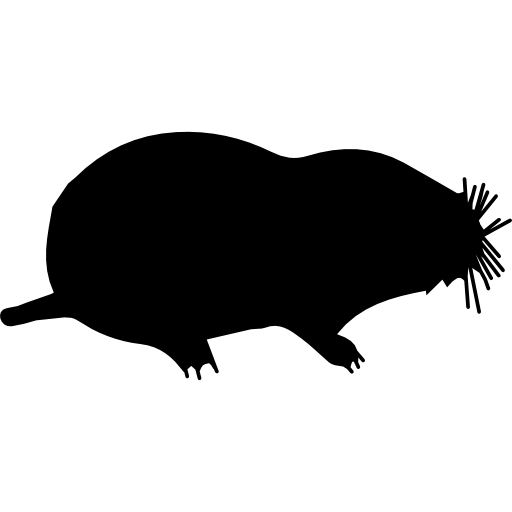
Small, thick-bodied creatures with narrow, pointed noses. Moles have broad front feet, the toes of which terminate in stout claws faced outward for digging. Their thick, plush like fur varies from grey to black and often has a pronounced sheen. Unlike the fur of most mammals, mole hair can move in any direction without standing on end, an adaptation that allows them to move in either direction in their tunnels with relative ease. Their ears are not visible and the eyes are very small.

The most common mole in the Fraser Valley is the Coast mole (Scapanus orarius)
Identification

Mass: 46-78g
Body length:145-181 mm
Tail length: 34 mm
Color: blackish brown
Young: 3-4 per litter
Habitat: Moist well- drained soils in riparian areas, meadows and deciduous forests.
Food: Primarily earthworms. Also eats snails, slugs, millipedes, centipedes and soil insects. 


Mole habitats on the lower mainland:

High Populated Areas: -99% of Golf Courses, Parks, Cemeteries, Residential Homes that surround green belts/forests/golf courses/cemeteries/parks etc.

-Well kept/healthy lawns (insect and worms)

-Equal activity from Vancouver to Abbotsford and North/West Vancouver 


Mole Control

Home Remedies, Exclusion and flooding are seldom effective

Moles will leave the  security of their tunnels during floods and swim to higher ground to avoid
drowning. Temporarily displaced moles that survive a flood will return home when the ground begins to dry and re-inhabit their vacated encampments. Flooding  mole tunnels in a dry soil using hundreds of gallons of  water may drown the mole or may force it to the surface where it can be killed. Attempting to drown moles in a sand to loam soil is usually futile. There are few obstacles they cannot negotiate. They can swim across rivers and canals, and burrow beneath highways and buildings.

 Home remedies such as placing hair, broken glass,  mothballs, motor oil, etc. in tunnels and liming the soil are rarely effective although such actions may repel the moles for a short time.  Chewing gum,  Alka-Seltzer, etc. are not effective.     

 Some cats provide good mole control. Occasionally a  cat learns to catch them as they push excavated earth out   
onto the surface of the ground. In most cases, the small gray animals that cats catch are shrews and since shrews   
are predatory on moles, such cats are actually contributing to the mole problem. 
Dogs can be taught to  dig up moles without digging up the entire lawn, but it is difficult.

Professional Mole Management 

Trapping

Most professionals use traps almost exclusively to control moles.  This is the most effective & humane way to eliminate the problem.  The secret is how and where to place the traps.  Because it takes considerable experience to become successful few professionals will share this information. If you want to try using traps yourself, give Holey Moley a call.  We offer a 20 to 30 minute on site instruction session and will provide the necessary equipment.


Our Services

 We provide professional programs designed to eliminate current mole activity and prevent further problems.
 Every program is different.  All aspects and surroundings must be taken into consideration when designing the
 most affective program and solution for your home or business.

Our Services are available 7 days a week.

On site Do It Yourself training session. Includes traps and a 20-30 minute lesson.

Our Experience: Over 10 years controlling moles 


Mole Prevention Tips:

If moles are active on your property or any surrounding areas, keep in mind that watering your lawn to much will increase the earthworms rising to the surface, a moles favorite snack, leaving surface tunnels caused by moles around your property.

-Non-Toxic Insect and grub control throughout the lawn will help keep the food source down, but may cause more “Mole Hills” as the search for food throughout the lawn will be greater.
  A good web site for more information:
   
 http://muextension.missouri.edu/explore/agguides/wildlife/g09440.htm


Contact Holey Moley

Holey Moley Mole Control Co.
Serving Greater Vancouver and the Fraser Valley
Phone:
Mission/Chilliwack:  604-217-4669
Greater Vancouver: 604-996-9433

   info@holeymoley.ca


  For information on other pest problems visit these web sites:

                       All-ProPestControl.ca

                      www.PestControlCanada.com